
ATMED SPACE
MEDICINE RESEARCH
Expanding knowledge of the kinematics, biomechanics and physiology of cardiopulmonary resuscitation (CPR) under altered gravitational conditions.
We conduct laboratory research and simulation studies on the performance of medical procedures under hypogravity and microgravity, with particular emphasis on resuscitation during future space missions.
ATMED SPACE
MEDICINE RESEARCH
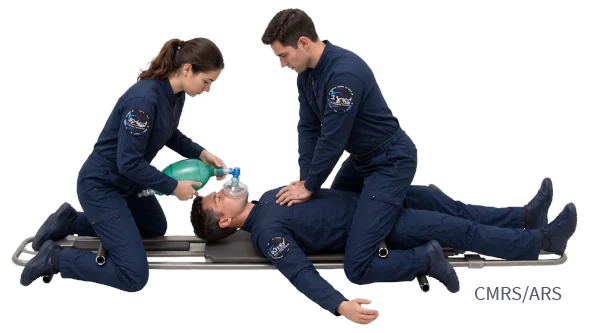
Advancing knowledge of the physiology and biomechanics of cardiopulmonary resuscitation (CPR) under hypogravity and microgravity conditions through laboratory research and simulation-based studies.

ARS DEVELOPMENT AND IMPLEMENTATION
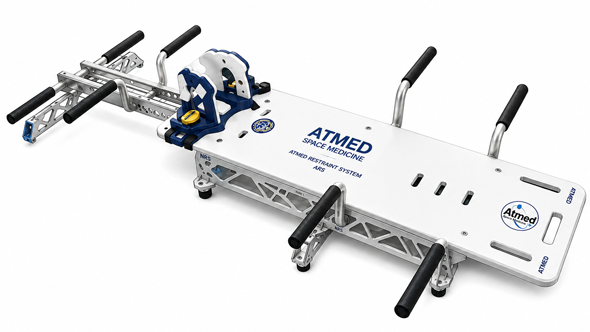
Research into the application of the Atmed Restraint System (ARS) – an innovative system for stabilizing the rescuer during medical procedures under altered gravitational conditions.
ARS enables stabilization of the rescuer’s position relative to the patient and allows the lower limbs to be used to generate and transfer forces during resuscitation in hypogravity and microgravity.
MOVEMENT BIOMECHANICS
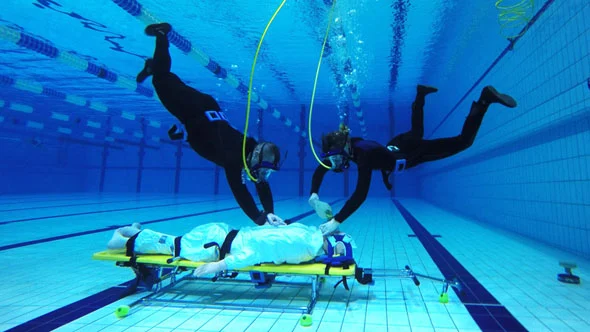
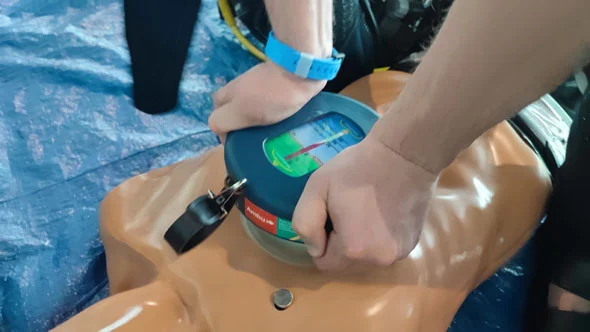
Investigation of movement kinematics and biomechanics during manual external chest compression (mECC) and airway ventilation under altered gravitational conditions.
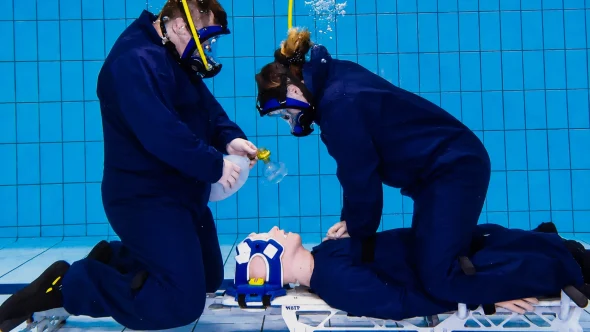
We analyze movement, body position, the direction and magnitude of applied forces, and the mechanics of performing procedures under conditions simulating Lunar-G and Zero-G, using neutral buoyancy, simulation platforms and parabolic flights.
MUSCLE ACTIVITY
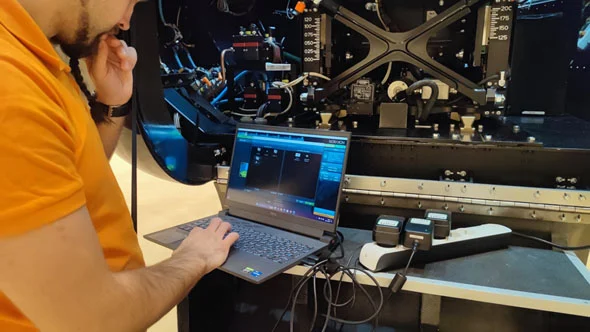
Assessment of muscle activity during resuscitation procedures under altered gravitational conditions.
We investigate the involvement of individual muscle groups during manual chest compression and airway ventilation, as well as the effect of changes in gravitational loading on the rescuer’s physical effort.
CHEST COMPRESSION AND AIRWAY VENTILATION EFFECTIVENESS
Assessment of the effectiveness of manual and automated chest compression and airway ventilation under altered gravitational conditions.
We analyze compression quality, continuity and parameters, as well as ventilation effectiveness, during simulated microgravity and hypogravity, including Lunar-G at 0.16 G.
HUMAN FACTORS
Investigation of the performance, efficiency and physiological responses of medical teams during emergency operations under altered gravitational conditions.
We analyze team cooperation, physical workload, psychophysiological demands and the influence of environmental conditions on the performance of medical procedures during space missions.
SCIENCE FOR LIFE. PREPARED FOR SPACE
Our research bridges space medicine, human performance, and emergency care to develop evidence-based solutions that save lives ort Earth and beyond.
SCIENCE FOR LIFE. PREPARED FOR SPACE
Our research bridges space medicine, human performance, and emergency care to develop evidence-based solutions that save lives ort Earth and beyond.
SCIENCE FOR LIFE. PREPARED FOR SPACE
Our research bridges space medicine, human performance, and emergency care to develop evidence-based solutions that save lives ort Earth and beyond.